



“Bitcoin is nothing. They can just be split into smaller parts named ‘bitcoin’, and suddenly more bitcoin has been created.”
A common criticism of bitcoin goes like this: if it can be divided endlessly, how can it ever be scarce? I will call it the divisibility argument in this text. It targets the 21 million bitcoin supply cap.
The intuition behind the argument is simple: if something can always be divided into smaller parts, then there will always be enough units for everyone. And if everyone can always get some, how can it be scarce? In this article I will steelman the divisibility argument and explore what merit it might have.
Because we are used to digital information being endlessly copyable, digital scarcity feels counter-intuitive.
Bitcoin is sometimes described as digital gold. Gold’s scarcity is protected by the fact that it is hard to increase the above-ground supply of gold. Gold’s physical properties make it extremely hard to create more of it. Because bitcoin is digital, it does not enjoy that kind of protection. Most digital information can be copied at negligible cost. This generally makes digital assets abundant, which seem to contradict the absolute scarcity bitcoin is claimed to have.
I will argue in this article that what protects bitcoin’s supply cap from being raised is the supply rules in its code in combination with broad consensus regarding those rules among the network participants.
The Bitcoin Supply
Let’s first go back to the bitcoin basics and talk about the bitcoin supply. The 21 million bitcoin cap is fairly well known. Bitcoin can be subdivided into satoshis and the satoshi is by far the most common subunit of bitcoin.
1 BTC = 100,000,000 satoshis
21,000,000 BTC = 2.1 quadrillion satoshis
The 2.1 quadrillion satoshi cap is less talked about, but just as valid. 2.1 quadrillion is a larger number than people normally deal with and therefore it can be perceived as infinite, but in reality it is absolutely finite. There will never be a single extra satoshi beyond this large number.
Both the bitcoin cap, and the resulting satoshi cap, are consequences of how the bitcoin code for the supply issuance schedule is written. The mathematical equation is expressed as:
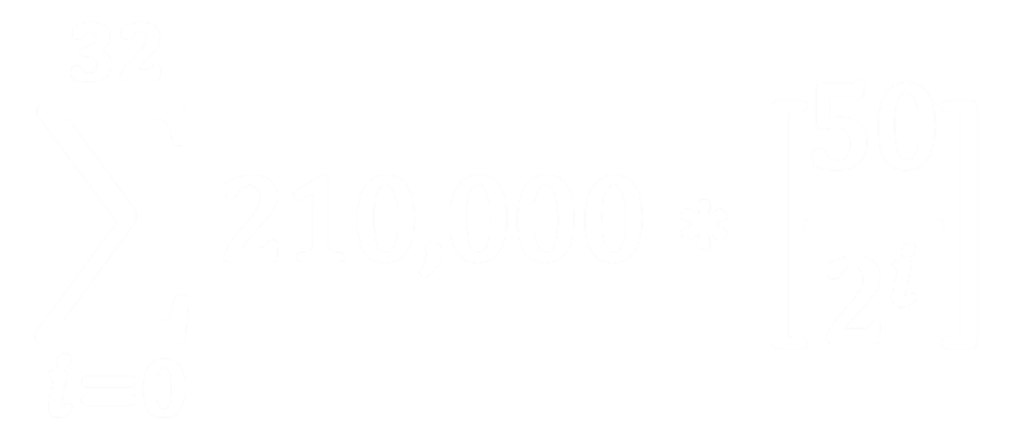
The corresponding code for this equation is publicly available, just as the rest of the bitcoin code.
The equation can be visualized as:
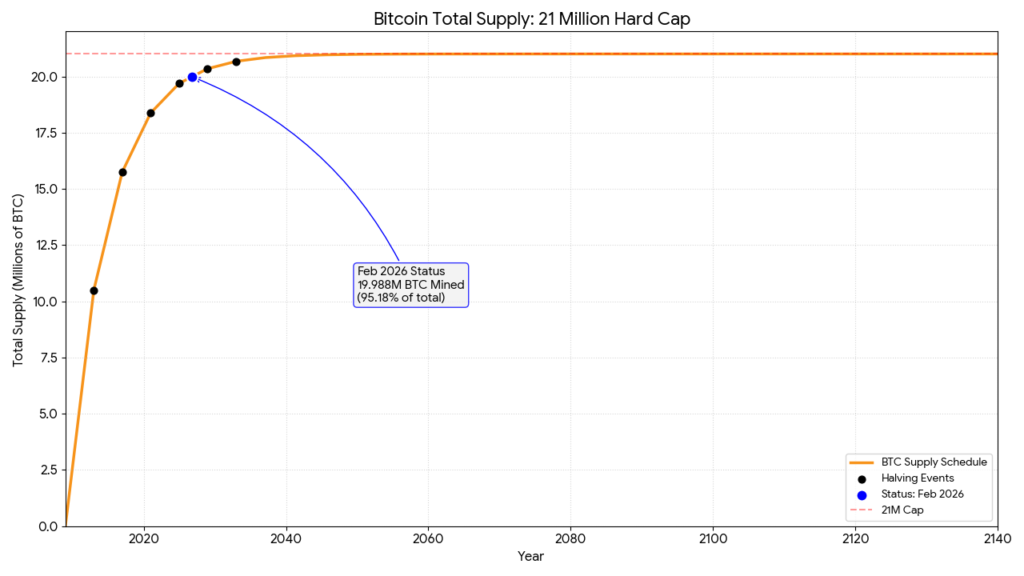
The inflation rate is currently below one percent and will continue approaching zero from here. The graph and the equation for satoshis would be structurally identical, only the scale of the y-axis would change. It is not out of the question that smaller units than satoshis are widely used in the future. However, to simplify this discussion we will focus on the bitcoin/satoshi relationship. The dynamic is the same for further division beyond satoshis.
Now we have covered the supply dynamics in the code. However, I have previously mentioned that the technology in itself does not protect bitcoin. In fact, any rules of the bitcoin supply described above can be changed. In the next section, we will explore this possibility.
Raising The Bitcoin Supply Cap
Everything about the bitcoin code could in theory be changed. Including the supply cap. From a purely technological standpoint, it is trivial to create a practically infinite amount of bitcoin. Such a change would send the scarcity to zero, and probably also the value of each coin. This means that there are no technical obstacles to the divisibility argument.
Bitcoin’s supply cap is protected by global consensus around the rules of the network among its participants.
However, a supply cap increase would require consensus in the network. Because the supply cap is one of the most sacred aspects of Bitcoin among the network participants, this is unlikely to happen. Moreover, the change would probably undermine Bitcoin’s credibility and that is not in the interest of a network participant. This means the incentives are aligned for the network participants to maintain the cap.
If there is an attempt to alter the cap, it is likely an attack on the network by a hostile attacking entity. The network participants will protect the network, because the incentives are such. A new network with a higher supply cap could then emerge from Bitcoin through a hard fork. That would then be a separate blockchain that would compete with the original and unchanged bitcoin.
We can conclude that a change to the bitcoin supply cap is technically possible, but very unlikely given the incentive structure for the network participants. Next, let us examine how the divisibility argument fits in this picture.
The Divisibility Argument
We have concluded that while it is technologically possible to change the supply cap, coordination would be very difficult. The divisibility argument states that you can get around the supply cap by dividing the 21 million units into smaller subunits. Could this division and further ones threaten the scarcity of bitcoin?
Divisibility is a vital characteristic of money.
Divisibility makes small and precise transactions possible, increasing economic efficiency. Changing the scale can be very useful as it allows for greater precision when stating a small amount of bitcoin, and this is used all the time in fiat currencies. One US dollar equals a hundred cents, and it does not matter if prices are stated in dollars or cents. What matters is the total purchasing power and not what the currency units used are called. We use the currency unit that is the most convenient for each transaction.
Expressing the same quantity in smaller units does not change the total supply. It only changes the scale.
Bitcoin is digital money. Dividing something in the digital realm might seem like just playing around with numbers. To make it easier to grasp the scarcity of bitcoin it can be helpful to make an analogy to the physical world. The following section introduces The Infinite Pizza Problem, which is probably the most commonly used analogy between scarcity in bitcoin and scarcity in the physical world.
The Infinite Pizza Problem

Imagine you have a normal sized pizza and that you only have that one pizza. The pizza is absolutely finite and will normally feed one person. Will cutting the pizza into a million minuscule parts make it feed a million people? Of course not. If you divide the pizza in a million parts you could call each tiny piece “a pizza”, but it wouldn’t be a pizza in the words original meaning. No one would accept a mere crumble as “a pizza”. The reason is that it does not retain the qualities one expects from a pizza, most importantly the calories.
Now, let’s think of a hypothetical scenario where a pizza doesn’t contain any calories and the only thing valued about pizza is its calories. The whole pizza is then equivalent to a crumble of it. The reason is that there is no value to divide in the first place.
The pizza’s divisibility does not make it less scarce.
An objection to the pizza analogy to bitcoin is that a pizza has a use case in that it can be eaten, while a bitcoin does not have such a use case. The argument is that bitcoin has just been assigned a price by the market but that it actually doesn’t have any underlying value. Bitcoin is likened with the pizza without calories.
Bitcoin has one use case, and that is the monetary one. As long as there is a value greater than zero assigned to bitcoin, other economic actors will care about the sizes of the subunits. One could argue whether bitcoin should be valued or not. However, it is a fact that bitcoin has a market price and that makes its currency units matter. Just as no one would accept a crumble in exchange for a full pizza, no one would accept a satoshi in exchange for a full bitcoin. The reason is that the purchasing power of one satoshi is much lower than that of one bitcoin.
The size of each piece only matters because the whole has value.
Let’s say we started calling satoshis “bitcoin” and the original bitcoin something else. No changes to the protocol, just the naming convention. The supply of what we call “bitcoin” would be a 100 million times larger than before, but every bitcoin owner would also have 100 million times more of it. Therefore, no dilution of ownership has happened. A rational merchant would still happily accept the new “bitcoin”, the price would just be set a 100 million times higher than before the change to compensate.
Conclusion
Critics have argued that bitcoin’s divisibility renders its supply cap a mere number that does not enforce scarcity. What I have argued for in this article is that dividing bitcoin into smaller units does not create more bitcoin, it only changes how ownership is expressed. The scarcity is not enforced by the bitcoin code, but by global consensus among the network participants. Furthermore, we have discussed how the market adapts to preserve bitcoin’s absolute scarcity for smaller units such as satoshis. We can conclude that the divisibility argument does not hold, making the underlying intuition held by many skeptics a divisibility fallacy as bitcoin’s scarcity survives division.