


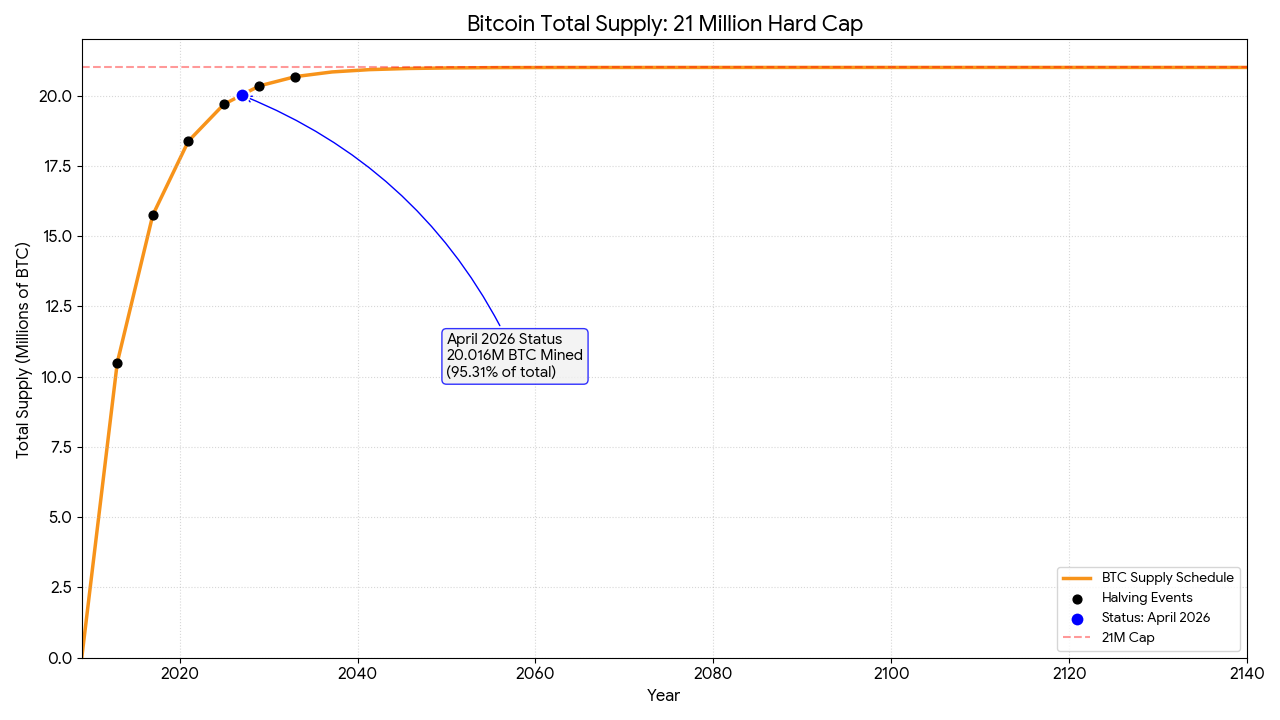
There are fewer than one million bitcoin left to be mined. A supply shock is about to hit the market.
This is the final stretch of a distribution that began in 2009 and has followed a fixed schedule ever since. In the 1900s the rush was for physical gold, this time it is for the digital gold.
This is the start of a digital gold rush.
What we are witnessing is the final run for the last satoshis. Not just to mine bitcoin, but to accumulate it before issuance fades out.
The system is quietly moving toward its final state.
The Early Phase Is Ending
When people hear that less than one million bitcoin remains, it triggers a familiar instinct. Scarcity feels like opportunity. It suggests that something valuable is about to become even harder to get.
More than 95% of the total supply is already in circulation. The period where large amounts of bitcoin could be accumulated through mining is behind us. That was the phase where participation required curiosity more than capital.
Today, mining is industrial. Competitive. Efficient.
The game has already professionalized, but that is just the beginning. What remains is not a window into early adoption, but a transition into maturity.
The Market Is Quietly Changing
As issuance declines, something more important is happening beneath the surface.
New supply is becoming irrelevant.
For most of Bitcoin’s history, newly mined coins mattered. They created consistent sell pressure as miners covered operational costs. This flow helped shape the market. But as block rewards shrink, that flow shrinks with it.
Bitcoin is transitioning from distribution to pure exchange.
Eventually, the market is no longer defined by new coins entering circulation. It is defined by existing holders choosing whether to sell.
This is one of the least discussed, but most important shifts in the system.
Scarcity Becomes Absolute
Scarcity is often misunderstood. It is not just about having a cap. Many assets are limited in some sense. What makes Bitcoin different is that its supply does not respond to price. Gold can become less scarce if the price rises enough to justify more extraction. The same is true for most commodities. Bitcoin does not behave this way.
No matter how high the price goes, the issuance schedule remains unchanged. No additional supply can be created. No future supply can be pulled forward.
Bitcoin is perfectly price-inelastic on the supply side.
As the remaining supply approaches zero, this property becomes impossible to ignore. The entire burden of price discovery shifts to the behavior of holders and buyers.
The Endgame
The final fraction of satoshis will be mined in more than a hundred years. But the reality is that almost all coins will have been mined in 2035. The issuance curve is designed to approach zero asymptotically.
This leaves a single decade to meaningfully accumulate. The mined coins will land in stronger and stronger hands.
Almost all bitcoin will have been mined in 10 years.
Bitcoin has been mined for 17 years. But the digital gold rush starts now.