


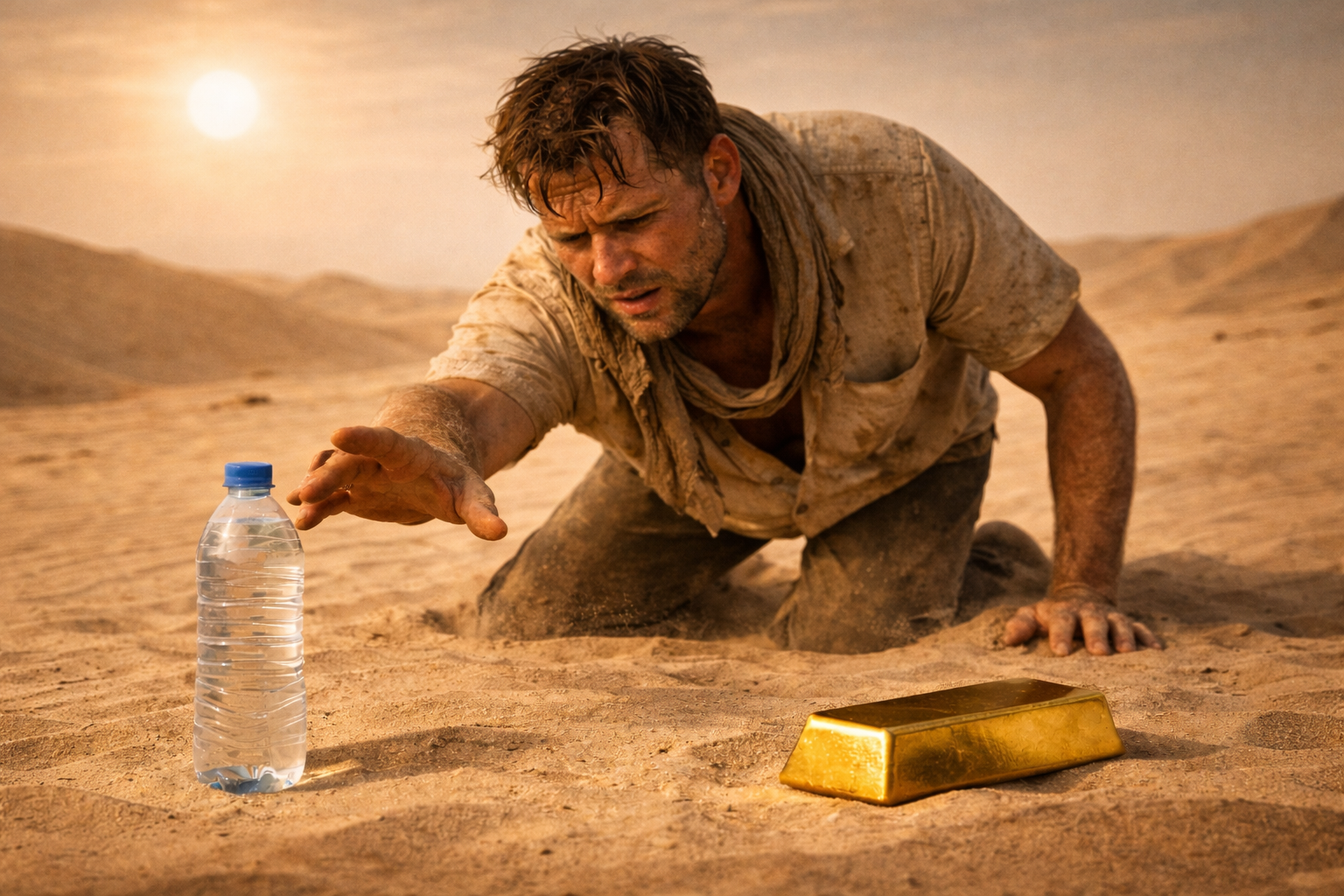
Gold is often said to have intrinsic value in debates about money. It is pointed out that, unlike Bitcoin, it can be used in jewelry and industry. This is sometimes taken as evidence that gold’s value is somehow built into the object itself. This article explores what value is and how it is assigned.
Properties Are Not Value
Gold has properties. It conducts electricity, resists corrosion, and is easy to shape. These properties make it useful for certain purposes. But usefulness is not the same as value. Usefulness only creates the possibility of value. Demand is what actually creates value.
If nobody wanted jewelry, gold’s role there would disappear. If it were replaced in electronics, that demand would also vanish. The properties would remain, but the value would not. Nothing about the gold changed. Only demand did. Properties only matter to those who need them.
Value Depends on the Situation
The same applies to anything else. Food contains calories, which can sustain life. This is an objective property. But the value of food still depends on whether someone needs or wants those calories. To someone who is starving, food is extremely valuable. To someone who is full, much less so.
Properties are objective. Value is assigned.
For someone lost in the desert, a bottle of water might be infinitely more valuable than a bar of gold. For someone sitting in the comfort of home with good access to water, the relation is often the opposite.
Value Is Relational
Value appears when someone cares about what those properties enable. Value is not contained in the object itself, but arises in the relationship between the object and the person evaluating it at a certain point in time.
Value does not live in things.
It lives in how we relate to them.
This is why the idea of intrinsic value is misleading. It suggests that value exists independently of human preferences. But without anyone to value something, there is no value to speak of.
Gold Has Multiple Uses, But One Price
Gold is often described as valuable because it serves many purposes. It can be used in jewelry, in industry, or held as a store of value. But these purposes should not be conflated.
Gold has multiple potential uses, but any given unit of gold can only serve one purpose at a time. Someone who holds gold as savings is not valuing its industrial use. Someone who uses it in production is not valuing it as money.
If gold stops being in demand as money, there will still be industrial demand. This creates a price floor above zero. While gold has an industrial price floor, it’s important to remember that even this floor is subjective. It depends on our current technology and desire for jewelry. If we found a cheaper substitute for gold in electronics, that “intrinsic” floor would drop. The properties of gold are constant, but the floor is as human-made as the ceiling.
What determines value is not how many uses something has, but which use people prioritize. The price of a thing reflects its most valued use at the margin.
Money Has Always Been Valued
Money is central to modern society. We rely on it daily to coordinate production, exchange, and savings. It is natural to think that something so essential must have other use cases than just being money, to ensure it holds value. But this is not the case.
Money has taken many forms throughout history. Shells, metals, paper, and now digital systems. Each of them has, at different times, been widely accepted and used. What they all had was not intrinsic value, but relational value. Each form of money reflected what was most practical at a given time and place. To some extent, they had the properties that characterize good money.
People accepted them because others accepted them. They were trusted as a way to store and transfer purchasing power. As long as this trust held, they had value in practice.
Bitcoin Is Designed as Money
Bitcoin was designed as money, and nothing else, from its birth. It therefore challenges the belief that money needs non-monetary uses to be valuable.
Bitcoin was not created to be used in industry or consumed in production.
Bitcoin was not built to have any “intrinsic value” or non-monetary use.
Bitcoin was created to function as money, and its design focuses on properties required for that role.
This is a feature, not a bug.
Bitcoin can be transferred globally, held without intermediaries, and has a fixed and predictable supply. These are not accidental features, but the result of a system designed specifically for storing and transferring purchasing power.
Bitcoin Is Valued As Money
Bitcoin does not derive value from industrial use. It derives value from the role it plays as money for its owners.
Gold is valued partly for its use as money. Bitcoin is valued only for its use as money. But in both cases, value comes from people and not from the object itself. This means that if Bitcoin fails as money, it has zero value.
Properties matter. But they only matter because people care about them.
Conclusion
There is no intrinsic value. Not in gold, not in Bitcoin, not in anything else.
There are only things, and our judgments about them.